

Genuinely unmetered rotating residential bandwidth is rare — most "unlimited" offers are either flat-rate thread/port billing (Storm Proxies, Proxyrack), a flat monthly rate on a fixed pool (ProxyScrape), or a fair-use policy that throttles speed past a threshold. If a provider bills you per GB, it isn't unlimited, no matter what the marketing copy says.
Our verified picks: Storm Proxies and Proxyrack for genuinely unmetered, flat-rate rotating residential; ProxyScrape for flat monthly unlimited on a smaller pool; and DataImpulse as the better-value alternative if you're open to pay-as-you-go with non-expiring traffic instead of "unlimited."
What "unlimited bandwidth" actually means
This is the part most guides skip, and it's the difference between picking a plan that fits your workload and getting throttled three weeks in. "Unlimited bandwidth" on a residential rotating proxy maps to one of four real things:
- Flat-rate thread or port billing. You pay for concurrent connections, not data volume — Storm Proxies and Proxyrack work this way. Bandwidth genuinely has no meter, but your throughput is capped by how many threads/ports you've paid for.
- Flat monthly rate on a fixed-size pool. You pay one price regardless of GB used, but the provider sizes the plan around expected usage — ProxyScrape's unlimited residential plans work this way.
- A fair-use policy with undisclosed throttling. "Unlimited" until you hit an undefined "normal usage" threshold, after which speed drops sharply. This is common with smaller providers and is functionally not unlimited.
- Datacenter or ISP proxies mislabeled as "unlimited residential." The IP itself carries unmetered bandwidth, but it's not a rotating residential IP — a different product entirely.
Because residential bandwidth costs providers real money (they're paying real people to share their connections), pure per-GB billing with no cap — like DataImpulse's $1/GB with non-expiring traffic — is often the more honest and ultimately cheaper option than chasing "unlimited," unless your usage is high and steady enough to make flat-rate math work in your favor.
What are residential rotating proxies?
Residential rotating proxies route your traffic through real home IP addresses rather than datacenter servers, and automatically switch to a new IP either on a timer or with every request. This makes your traffic look like it's coming from many different genuine users instead of one high-volume source, which lowers the chance of being detected and blocked during scraping, research, or account management tasks.
| Provider | Billing Model | Truly Unmetered? | IP Pool | Rotation | Entry Price |
|---|---|---|---|---|---|
| Storm Proxies | Flat-rate per port | Yes | 700,000+ | Every 5 minutes | $50/month (5 ports) |
| Proxyrack | Flat-rate per thread | Yes | 5M–35M+ (varies by product) | Rotating or sticky | ~$50/mo entry; unmetered residential from ~$199/mo (100 threads) |
| ProxyScrape | Flat monthly rate | Yes | 4M+ | Rotating | Custom flat-rate plans (contact sales) |
| LunaProxy | Pay-as-you-go per GB | No — metered | 200M+ | Every 90 minutes | ~$0.77–$3.30/GB (sources vary) |
| DataImpulse (alternative) | Pay-as-you-go per GB, non-expiring | No, but nothing wasted | 90M+ | Rotating or sticky | $1/GB |

Bills per port, not per GB, so bandwidth is genuinely uncapped on every plan. Smaller pool (~700,000 IPs), US/EU only, with automatic 5-minute rotation and a 24-hour money-back guarantee.
Good at
Watch out

Best for: Steady, moderate-volume tasks like SEO monitoring.
Avoid if: You need IPs outside the US or Europe.

Unmetered residential billed by concurrent threads, not data. Entry from ~$50/month; dedicated unmetered residential from ~$199/month (100 threads). 5M-35M+ IPs across 140+ countries with city/ISP targeting.
Good at
Watch out

Best for: Sustained, high-volume scraping and monitoring.
Avoid if: Your usage is light, occasional, or experimental.
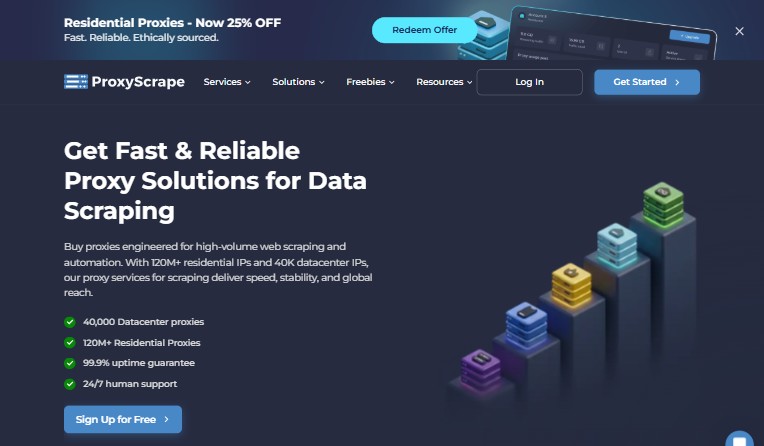
A genuinely flat-rate "Unlimited Residential" product — one fixed monthly price regardless of GB used, from a 4M+ IP pool across 180+ countries. Built for large, continuous operations like model training or 24/7 scraping.
Good at
Watch out
Best for: Large, continuous data collection with a fixed budget.
Avoid if: You want a published, self-serve price online.

A genuinely large pool (200M+ claimed IPs) at low per-GB rates ($0.77-$3.30/GB depending on source). But it's billed per GB — that's metered pricing, not unlimited bandwidth, regardless of how it's marketed.
Good at
Watch out

Best for: Defined data budgets wanting pool size and low $/GB.
Avoid if: You specifically need flat-rate, uncapped billing.
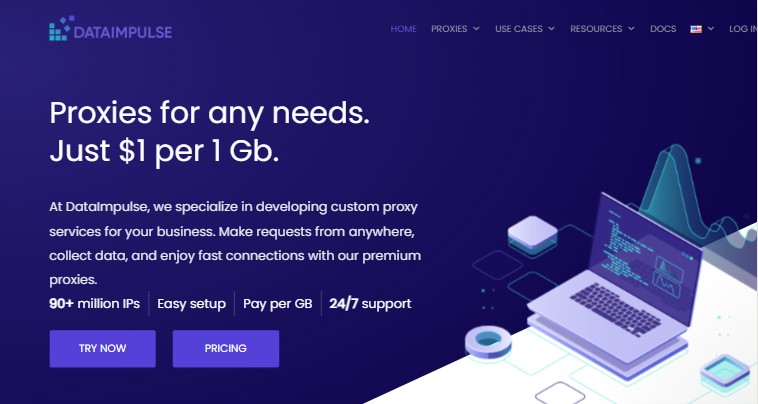
$1/GB pay-as-you-go with traffic that never expires — no monthly reset, no fair-use throttling clause. On a 90M+ first-party pool across 195 countries, it often beats flat-rate "unlimited" plans unless your usage is high and consistent enough for that math to win.
Good at
Watch out
Best for: Bursty or unpredictable usage that hates wasted spend.
Avoid if: Your volume is high and steady enough for flat-rate to win.
What to check before buying
suits tasks needing session continuity, like account logins.
Confirm location coverage matches your target. Storm Proxies' US/EU-only pool won't help if you need Asia-Pacific coverage; check country-level availability, not just total pool size.
Read the fair-use policy, not just the plan name. If a provider uses the word "unlimited" without a thread or port-based billing structure behind it, look for a fair-use clause — it's usually there, and it defines your real ceiling.
Test before committing to an annual plan. Paid trials (Storm Proxies' 24-hour guarantee, Proxyrack's $13.95 trial) are cheap ways to validate real-world success rates against your actual target sites.
FAQs
It's a residential rotating proxy sold under a billing model that doesn't meter data by the gigabyte — usually flat-rate thread/port pricing or a fixed monthly fee — rather than a proxy with no practical limits at all. Genuine unmetered residential bandwidth is uncommon; always confirm the actual billing model before assuming "unlimited" means uncapped.
A residential proxy is an IP address connected to a home internet service. A rotating proxy is a special type of residential proxy that automatically changes to different IP addresses to hide your real IP address.
"Residential" describes the IP source (a real home internet connection rather than a datacenter server); "rotating" describes the behavior (the IP automatically changes over time or per request). A proxy can be residential and static, or datacenter and rotating — the two terms describe different things and aren't interchangeable.
Wrapping Up
Hopefully, you now have a pretty good idea of the best residential rotating proxies with unlimited bandwidth in 2026.
If you need to collect data, visit blocked websites, or stay anonymous online, using residential rotating proxies with unlimited data is the best choice.
If you want to learn about the best and cheapest Residential Proxies in 2026, check out this detailed guide.